Description
This Rotorcraft Aerodynamics For Vtol Engineers eBook from 3D-LABS is written for engineers and students who want a clear, practical reference they can apply immediately.
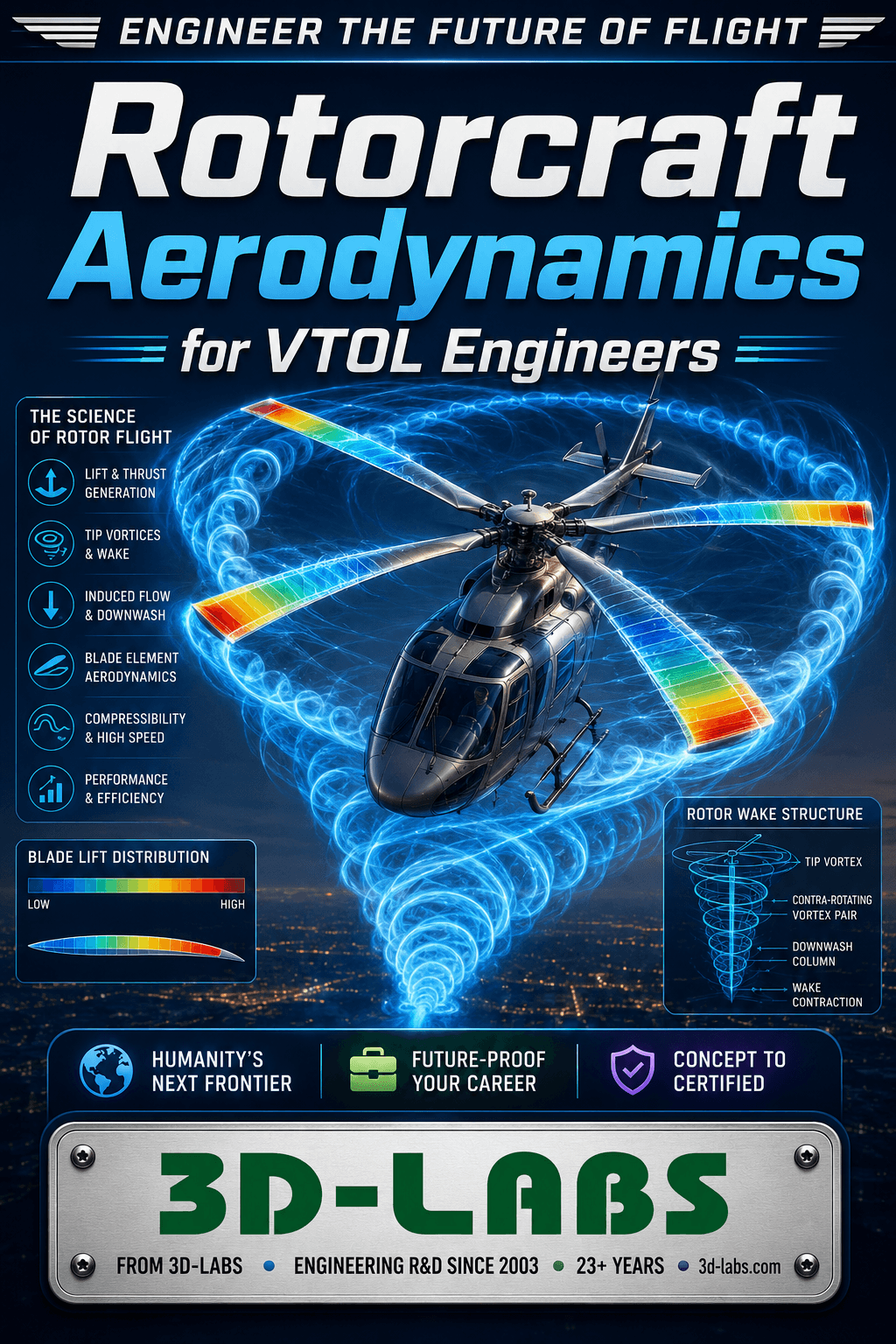
Rotorcraft Aerodynamics for VTOL Engineers covers blade element momentum theory, vortex wake models, ground effect, autorotation, and compound VTOL configurations for helicopter and VTOL rotor design.
What standards does this book reference?
FAR Part 27 (normal category rotorcraft), FAR Part 29 (transport rotorcraft), EASA CS-27/CS-29, and ADS-33E-PRF for rotorcraft handling qualities.
What is the rotor hover thrust equation?
Momentum theory: T = 2*rho*A*v_h^2, where rho is air density, A = pi*R^2 rotor disk area. Figure of Merit FM = T^(3/2)/(sqrt(2*rho*A)*P_ideal), typically 0.75-0.80 for well-designed rotors. Blade element method refines for pitch, twist, planform, and tip loss.
What eVTOL and UAM content is included?
Distributed electric propulsion (DEP) aerodynamic interaction effects, multi-rotor power loading W/P trade-offs, tilt-rotor transition aerodynamics, and DGCA BVLOS RPAS rules for Indian UAM.
How do I access this book after purchase?
eBook PDF: Instant download via email and 3D-LABS dashboard. Paper Book: Printed and shipped to India.
What’s Included
An instant PDF download covering the core concepts, practical examples, and key references — ready to read on any device.
Related Reading
- Aircraft Conceptual Design for the New Aviation
- Urban Air Mobility — System Design from Vehicle to Vertiport
- eVTOL Design — Aerodynamics, Propulsion, Certification
Download the Rotorcraft Aerodynamics for VTOL Engineers e-book from 3D-LABS — instant PDF access with lifetime re-downloads.
About Rotorcraft Aerodynamics for VTOL Engineers
Rotorcraft Aerodynamics for VTOL Engineers is part of the 3D-LABS Urban Air Mobility (UAM) series — a focused e-book library for aerospace engineers, urban planners, and mobility strategists working on the future of urban transport. This title covers eVTOL aircraft design, vertiport infrastructure, air traffic management for UAM, and regulatory frameworks, with worked examples and industry-current best practices drawn from real urban air mobility projects.
Written by practising 3D-LABS engineers and reviewed by senior specialists, Rotorcraft Aerodynamics for VTOL Engineers is designed to move you from concept to competence quickly — not to be a comprehensive academic reference, but a working reference you actually use.
Who Rotorcraft Aerodynamics for VTOL Engineers is for
Rotorcraft Aerodynamics for VTOL Engineers is written for aerospace engineers, urban planners, and mobility strategists working on the future of urban transport. If you are:
- An early-career engineer wanting to accelerate your practical knowledge in urban air mobility.
- An experienced practitioner looking for a compact reference on current practices.
- A student preparing for engineering exams, interviews, or your first professional role.
- A manager or team lead wanting to level-set your team on urban air mobility fundamentals.
Then Rotorcraft Aerodynamics for VTOL Engineers will earn its price back in the first project or exam you apply it to.
What is included in your download
- The complete PDF e-book — DRM-free, fully searchable, print-friendly formatting.
- Worked examples — real-world calculations, drawings, or case studies interspersed through the text.
- Reference charts and tables — quick-lookup material you will return to on the job.
- Further reading recommendations — curated pointers to codes, standards, and complementary resources.
- Free updates — when we revise the book, you get the updated PDF at no extra cost. We notify you by email.
Pricing and delivery
Rotorcraft Aerodynamics for VTOL Engineers is priced at ₹4,950 (USD equivalent shown in cart). Delivery is instant — after payment, the download link is emailed to you and available in your account. No subscriptions, no hidden fees, no expiring access.
Payment methods: Cashfree (Indian customers) or PayPal International (customers outside India). Bulk licensing available for corporate training programmes and educational institutions — contact sales@3d-labs.com.
How to get the most out of Rotorcraft Aerodynamics for VTOL Engineers
- Read the introduction and structure first — every book has a "how to use this book" section that maps chapters to the reader you are.
- Work through the examples with pen and paper — passive reading is 10% retention; working the calculation yourself is 70%+.
- Cross-reference with the 3D-LABS spreadsheet library — 680 Excel calculation tools that pair naturally with our e-books.
- Apply the concepts to a real project immediately — the book will pay for itself the first time you avoid a design error.
- Come back to the book after 6 months — with real project experience, you will read the same chapters differently.
Related titles and services
Readers of Rotorcraft Aerodynamics for VTOL Engineers typically also work with:
- Other titles in the Urban Air Mobility (UAM) book series — currently 4 titles.
- The Aerospace & Defence Engineering — for projects where you need experienced urban air mobility engineers directly.
- Our 680 engineering calculation spreadsheets — Excel tools that complement the theory in this book.
- Our online training courses — instructor-led programmes on urban air mobility topics.
Frequently asked questions
What format is Rotorcraft Aerodynamics for VTOL Engineers delivered in?
Rotorcraft Aerodynamics for VTOL Engineers is delivered as an instant-download PDF file. The PDF is DRM-free, works on any device (desktop, tablet, phone, e-reader), and is fully searchable. Print-friendly formatting so you can print for offline reading.
How is this different from a paper textbook?
This e-book is a focused, practical guide — targeting a specific engineering skill or knowledge area. Unlike a 600-page academic textbook, it moves quickly to real-world applications with worked examples, industry practices, and current code references. Priced accordingly.
Who wrote this book?
Books in the Urban Air Mobility (UAM) series are authored by 3D-LABS engineers and reviewed by senior specialists in the field. Every author has hands-on industry experience — this is not academic theory, it is applied practice from working engineers.
Can I use the material for teaching or training?
Purchase includes single-user rights. For classroom use, corporate training programmes, or bulk licensing, contact us at info@3d-labs.com — we offer institutional licensing and custom-branded editions for training programmes.
What if the content does not meet my expectations?
We offer a 7-day satisfaction guarantee. If Rotorcraft Aerodynamics for VTOL Engineers does not deliver the value you expected, email us within 7 days of purchase for a full refund. No questions asked — we would rather have satisfied customers than unhappy ones.
About 3D-LABS engineering e-books
Rotorcraft Aerodynamics for VTOL Engineers is one of 115 titles in the 3D-LABS e-book library — the largest collection of practitioner-authored engineering e-books available anywhere, spanning 14+ series from engineering fundamentals to future technology and urban air mobility. Every book is written and reviewed by 3D-LABS engineers who use the concepts daily on real client projects across the globe.
Browse the full e-book library, or explore other content options: 680 spreadsheets, 19 online courses, or our full engineering services.
Why buy from 3D-LABS
Published by a working engineering practice
Our titles are written and published by 3D-LABS, an engineering design practice working since 2003 for operators and EPC contractors across Asia, the Middle East, Africa and Australia.
- 2003Engineering since
- 12Countries delivered into
- 50+Named client organisations
- 14Design codes worked to
Codes our engineers design to
- ASME
- API
- AWWA
- TEMA
- PD 5500
- AISC
- IS 800
- EN
- IBR
Questions on anything in the book? Write to us — a working engineer answers, not a support desk.Design and detailing for Larsen & Toubro, Emerson, PetroFac, Qatar Petroleum, ADCO and Samsung Engineering since 2003.