Description
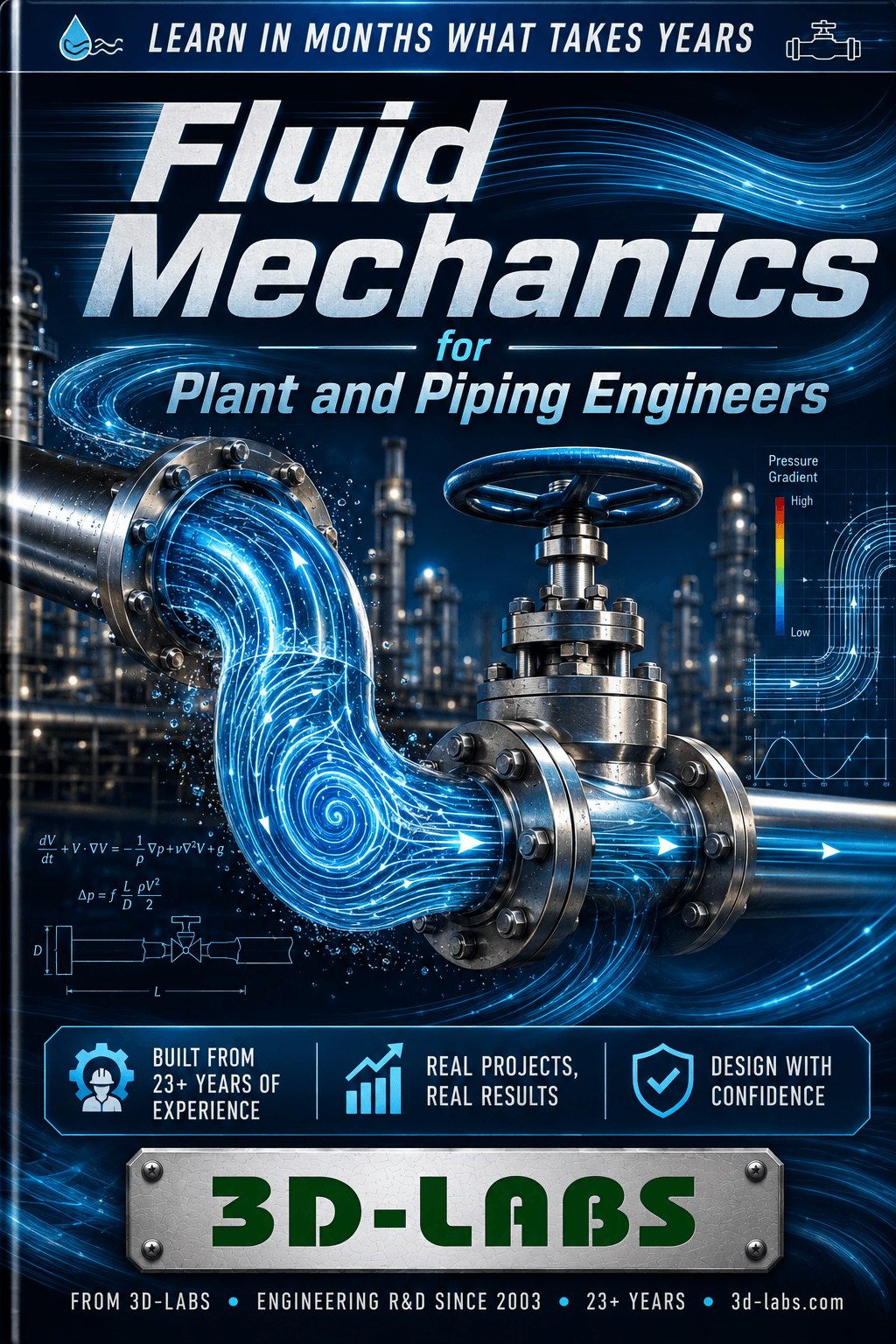
This Fluid Mechanics For Plant And Piping Engineers eBook from 3D-LABS is written for engineers and students who want a clear, practical reference they can apply immediately.
This e-book covers fluid mechanics specifically for process plant and piping engineers: pipe flow calculations, pump sizing, two-phase flow, pressure relief valve sizing, and compressible flow — all referenced to ASME B31.3, API RP 520 (Part I), API RP 521, and ISO 4126. It bridges the gap between academic fluid mechanics and the actual calculations required on an EPC piping isometric package.
What does this book cover?
See the full description below for chapter-by-chapter contents, worked examples, and download format details.
Frequently Asked Questions
What pipe flow formulas are covered in this book?
The book covers: Darcy-Weisbach (ΔP = f × L/D × ρV²/2, where f from Moody chart or Colebrook-White equation), Hazen-Williams (V = 0.8492 × C × R^0.63 × S^0.54 for water), Manning equation for open channels, and the API RP 14E erosional velocity limit (Ve = C/√ρ, C = 100 for continuous service, C = 125 for intermittent per API RP 14E Clause 2.4c).
How does this book cover pressure relief valve sizing?
PSV sizing per API RP 520 Part I (10th Ed., 2020): for vapour service A = W/(CKdP1Kb√(M/TZ)) and for liquid service A = Q/(38Kd × Kw × Kc × √(ΔP/G)). The book covers fire case sizing per API RP 521 (7th Ed., 2020) and the 10 overpressure scenarios in API RP 521 Annex A that must be evaluated for every process vessel.
What two-phase flow correlations are included?
Lockhart-Martinelli correlation for horizontal two-phase pipe flow (void fraction and pressure drop), Baker chart for flow regime identification, and the Beggs-Brill correlation for inclined two-phase flow — the method used in PIPESIM and OLGA process simulators. The book explains when each applies and how to select the conservative correlation for safety systems.
What’s Included
An instant PDF download covering the core concepts, practical examples, and key references — ready to read on any device.
Related Reading
- Two-Phase Flow Pressure Drop Calculation — Gas-Liquid Piping Excel
- Line Sizing & Pressure Drop Calculation — Darcy-Weisbach Excel
- Gas Line Sizing by Velocity Calculation — Pipeline Sizing Excel
Download the Fluid Mechanics for Plant and Piping Engineers e-book from 3D-LABS — instant PDF access with lifetime re-downloads.
About Fluid Mechanics for Plant and Piping Engineers
Fluid Mechanics for Plant and Piping Engineers is part of the 3D-LABS Engineering series — a focused e-book library for practising engineers, engineering students, and technical managers. This title covers fundamentals of engineering design, code interpretation, industry practices, and real-world project applications, with worked examples and industry-current best practices drawn from real engineering projects.
Written by practising 3D-LABS engineers and reviewed by senior specialists, Fluid Mechanics for Plant and Piping Engineers is designed to move you from concept to competence quickly — not to be a comprehensive academic reference, but a working reference you actually use.
Who Fluid Mechanics for Plant and Piping Engineers is for
Fluid Mechanics for Plant and Piping Engineers is written for practising engineers, engineering students, and technical managers. If you are:
- An early-career engineer wanting to accelerate your practical knowledge in engineering.
- An experienced practitioner looking for a compact reference on current practices.
- A student preparing for engineering exams, interviews, or your first professional role.
- A manager or team lead wanting to level-set your team on engineering fundamentals.
Then Fluid Mechanics for Plant and Piping Engineers will earn its price back in the first project or exam you apply it to.
What is included in your download
- The complete PDF e-book — DRM-free, fully searchable, print-friendly formatting.
- Worked examples — real-world calculations, drawings, or case studies interspersed through the text.
- Reference charts and tables — quick-lookup material you will return to on the job.
- Further reading recommendations — curated pointers to codes, standards, and complementary resources.
- Free updates — when we revise the book, you get the updated PDF at no extra cost. We notify you by email.
Pricing and delivery
Fluid Mechanics for Plant and Piping Engineers is priced at ₹3,500 (USD equivalent shown in cart). Delivery is instant — after payment, the download link is emailed to you and available in your account. No subscriptions, no hidden fees, no expiring access.
Payment methods: Cashfree (Indian customers) or PayPal International (customers outside India). Bulk licensing available for corporate training programmes and educational institutions — contact sales@3d-labs.com.
How to get the most out of Fluid Mechanics for Plant and Piping Engineers
- Read the introduction and structure first — every book has a "how to use this book" section that maps chapters to the reader you are.
- Work through the examples with pen and paper — passive reading is 10% retention; working the calculation yourself is 70%+.
- Cross-reference with the 3D-LABS spreadsheet library — 680 Excel calculation tools that pair naturally with our e-books.
- Apply the concepts to a real project immediately — the book will pay for itself the first time you avoid a design error.
- Come back to the book after 6 months — with real project experience, you will read the same chapters differently.
Related titles and services
Readers of Fluid Mechanics for Plant and Piping Engineers typically also work with:
- Other titles in the Engineering book series — currently 12 titles.
- The Engineering Design Services — for projects where you need experienced engineering engineers directly.
- Our 680 engineering calculation spreadsheets — Excel tools that complement the theory in this book.
- Our online training courses — instructor-led programmes on engineering topics.
Frequently asked questions
What format is Fluid Mechanics for Plant and Piping Engineers delivered in?
Fluid Mechanics for Plant and Piping Engineers is delivered as an instant-download PDF file. The PDF is DRM-free, works on any device (desktop, tablet, phone, e-reader), and is fully searchable. Print-friendly formatting so you can print for offline reading.
How is this different from a paper textbook?
This e-book is a focused, practical guide — targeting a specific engineering skill or knowledge area. Unlike a 600-page academic textbook, it moves quickly to real-world applications with worked examples, industry practices, and current code references. Priced accordingly.
Who wrote this book?
Books in the Engineering series are authored by 3D-LABS engineers and reviewed by senior specialists in the field. Every author has hands-on industry experience — this is not academic theory, it is applied practice from working engineers.
Can I use the material for teaching or training?
Purchase includes single-user rights. For classroom use, corporate training programmes, or bulk licensing, contact us at info@3d-labs.com — we offer institutional licensing and custom-branded editions for training programmes.
What if the content does not meet my expectations?
We offer a 7-day satisfaction guarantee. If Fluid Mechanics for Plant and Piping Engineers does not deliver the value you expected, email us within 7 days of purchase for a full refund. No questions asked — we would rather have satisfied customers than unhappy ones.
About 3D-LABS engineering e-books
Fluid Mechanics for Plant and Piping Engineers is one of 115 titles in the 3D-LABS e-book library — the largest collection of practitioner-authored engineering e-books available anywhere, spanning 14+ series from engineering fundamentals to future technology and urban air mobility. Every book is written and reviewed by 3D-LABS engineers who use the concepts daily on real client projects across the globe.
Browse the full e-book library, or explore other content options: 680 spreadsheets, 19 online courses, or our full engineering services.
Why buy from 3D-LABS
Published by a working engineering practice
Our titles are written and published by 3D-LABS, an engineering design practice working since 2003 for operators and EPC contractors across Asia, the Middle East, Africa and Australia.
- 2003Engineering since
- 12Countries delivered into
- 50+Named client organisations
- 14Design codes worked to
Codes our engineers design to
- ASME
- API
- AWWA
- TEMA
- PD 5500
- AISC
- IS 800
- EN
- IBR
Questions on anything in the book? Write to us — a working engineer answers, not a support desk.Design and detailing for Larsen & Toubro, Emerson, PetroFac, Qatar Petroleum, ADCO and Samsung Engineering since 2003.