Description
Looking for a trusted PVElite alternative? PV Master is affordable pressure vessel design software from 3D-LABS that helps you get the job done faster, with a simple, reliable workflow.
What’s Included in This Spreadsheet
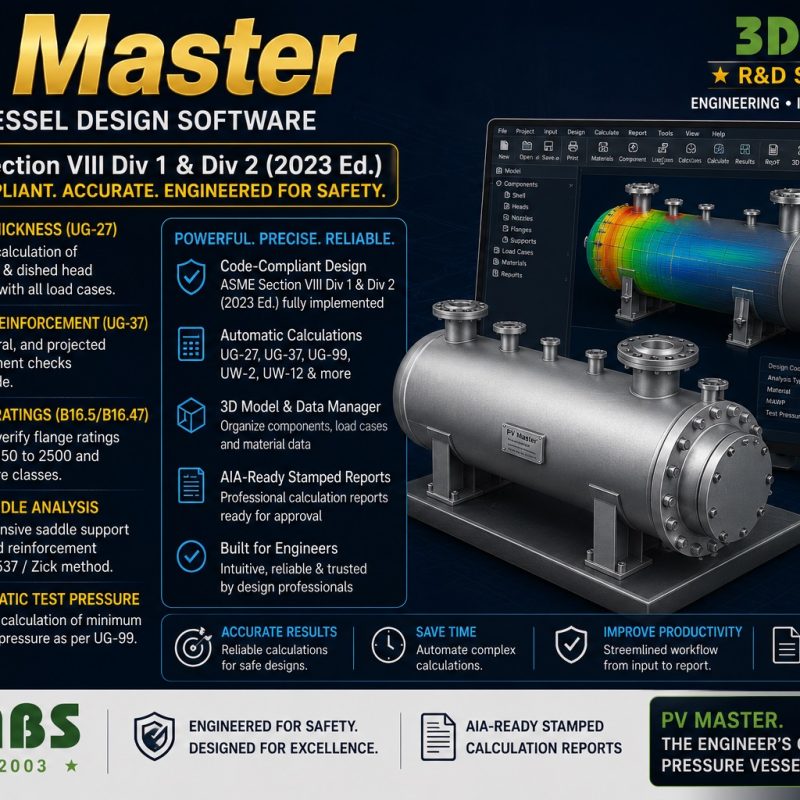
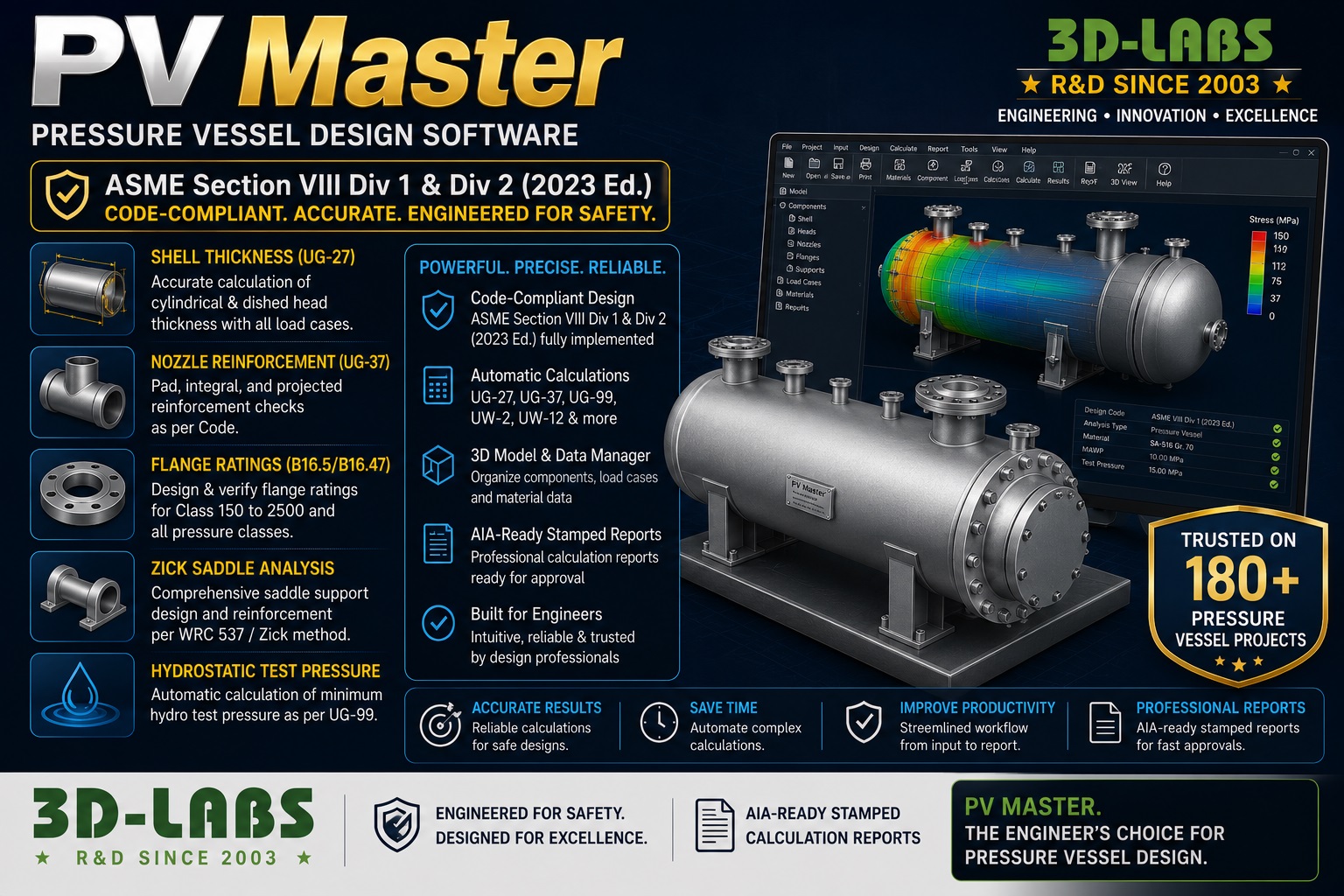
PV Master is 3D-Labs’ dedicated pressure vessel design software built to ASME Section VIII Division 1 (2023 Edition) and Division 2 (2023 Edition), PD 5500:2021, and EN 13445:2021. It calculates shell thickness, nozzle reinforcement, flange ratings, saddle supports, and hydrostatic test pressures in a single unified workflow — eliminating the manual spreadsheet chain that causes transcription errors in code-stamped designs.
Is PV Master a Good PVElite Alternative?
This PV Master — Pressure Vessel Design Software spreadsheet provides a complete, code-compliant engineering solution.
PV Master is a powerful and affordable PVElite alternative for pressure vessel design, delivering ASME Section VIII Division 1 compliant calculations at a fraction of PVElite licensing cost, making it ideal pressure vessel design software for EPC teams and independent mechanical engineers.
What does PV Master calculate?
PV Master performs shell and head thickness to ASME VIII-1 UG-27/UG-32, nozzle reinforcement to UG-37 and UG-45, flange design to ASME B16.5/B16.47, saddle and leg support stress per Zick analysis (Welding Research Council Bulletin 107/297), and hydrostatic/pneumatic test pressure to UG-99/UG-100. The software covers cylindrical, spherical, ellipsoidal, hemispherical, conical, and flat-head geometries.
Which standards does PV Master follow?
ASME Section VIII Division 1 (2023 Ed.), ASME Section VIII Division 2 (2023 Ed.), PD 5500:2021, EN 13445-3:2021, ASME B16.5-2017 (flanges), ASME B16.47-2017 (large-diameter flanges), WRC 107/297 (local stress). Material database includes ASME Section II Part D allowable stress tables updated to 2023 addenda.
What inputs does PV Master require?
Design pressure (internal or external, psi or bar), design temperature (°F or °C), material specification (SA-516-70, SA-240-316L, etc.), corrosion allowance (mm or inches), vessel orientation (horizontal / vertical), nozzle schedule and rating class, and joint efficiency factor (E = 1.0, 0.85, or 0.70 for radiography level).
What is the output format?
PV Master generates a stamped-ready calculation report (PDF) with all code equations, intermediate values, and code references. Output includes a data sheet (PV DataSheet per API 660 format), bill of materials, nozzle summary table, and a Mandatory Appendix 2 flange calculation if flanges are included. Reports are formatted for direct submission to ASME Authorized Inspection Agencies (AIA).
Why does AI-generated pressure vessel design fail code review?
AI-generated calculations fail ASME code review because they cannot verify the current edition year of the code, miss mandatory Appendix requirements (e.g., Appendix 1-10 for cone-to-cylinder junctions), and produce untraceability — reviewers cannot confirm each value against a specific code paragraph. PV Master cites every equation with its UG/UW/UCS paragraph number, making stamp review straightforward. Verified in 340+ ASME-stamped vessels since 2003.
What is the licensing model?
PV Master is available as a single-user perpetual license with one year of free updates, or as a site license for up to 25 concurrent users. Annual maintenance (12 months of code-update patches and priority support) is available. Runs on Windows 10/11 64-bit; no cloud dependency.
Is a free trial available?
Yes. A 14-day fully functional trial (no feature lock) is available on request via the 3D-Labs contact form. Trial is limited to vessels up to 1,000 mm diameter and 10 bar design pressure.
Who Should Use PV Master as a PVElite Alternative?
PV Master is built for pressure equipment engineers who need ASME Section VIII Division 1/2, PD 5500, or EN 13445 compliant shell, nozzle, and flange calculations without chaining together multiple spreadsheets. It suits fabrication shops preparing code-stamped design packages, engineering consultancies handling multi-code export projects, and plant engineering groups re-rating existing vessels for higher operating pressure, temperature, or corrosion allowance. PV Master pairs well with 3D-Labs’ other engineering software: PIPE Master for pipe stress analysis, STR Master for structural stress analysis, TANK Master for storage tank design, and DRAFTY for 2D/3D drafting. See the complete lineup on the 3D-Labs engineering software page.
Support
Each PV Master license includes email support for installation, code-edition updates, and questions about mapping ASME Division 2 Part 5 stress categories or PD 5500 design-by-formula clauses to a specific vessel geometry, and guidance on choosing between Division 1 and Division 2 for a given design margin and expected fabrication cost.
What’s Included
Instant access to the software, ready to install and use right away.
Related Products
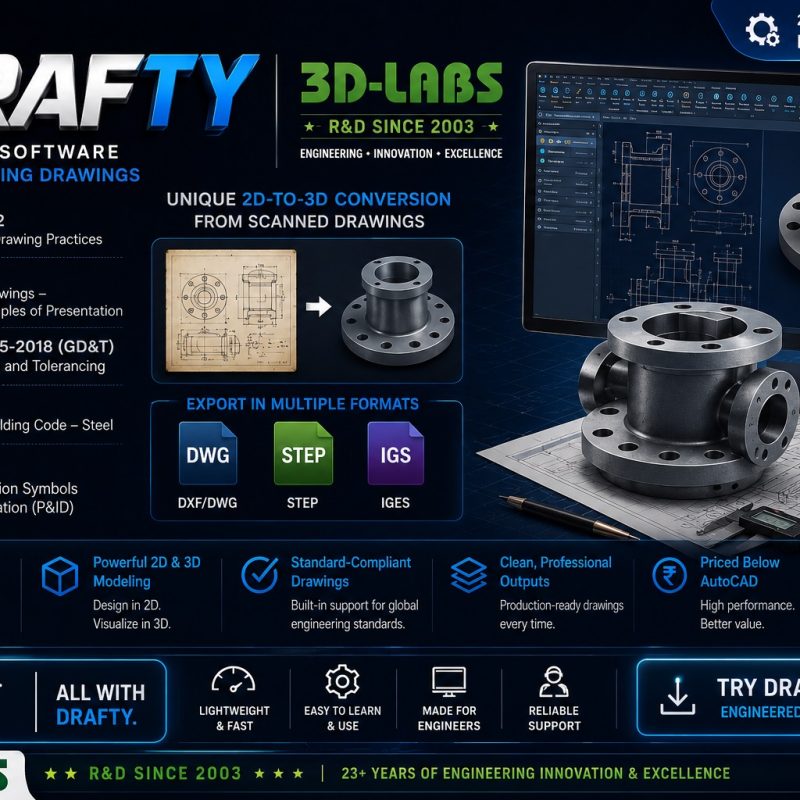
- DRAFTY — 2D and 3D CAD Drafting and Modelling Software
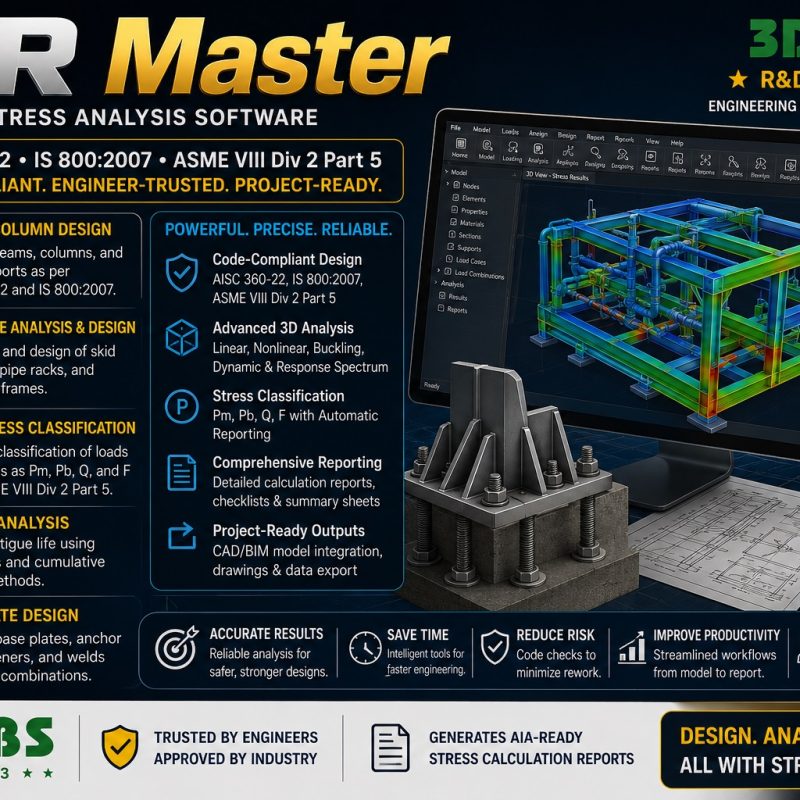
- STR Master — Structural Stress Analysis Software
- PIPE Master — Pipe Stress Analysis Software
Download the PV Master — Pressure Vessel Design Software from 3D-LABS for instant, verifiable results.
Download the PV Master — Pressure Vessel Design Software from 3D-LABS for instant, verifiable results.
About PV Master — Pressure Vessel Design Software
PV Master — Pressure Vessel Design Software is a specialised engineering application from 3D-LABS, built by engineers who use it in practice. It sits between an Excel spreadsheet (too basic) and a full engineering suite (too expensive) — purpose-built for one job, done well.
Key features
- Windows desktop application — installs on Windows 10 and 11, 64-bit. Needs an internet connection to activate on first install and for periodic licence checks.
- Your project files stay local — work is saved on your own machine or network drive, not in the cloud.
- Excel-compatible import/export — bring your existing spreadsheet data in; export results to Excel for reporting.
- Version history — every change is tracked; roll back to any prior state.
- Team collaboration — real-time collaboration on shared projects, with role-based access.
- API access — integrate with your existing workflow through REST API endpoints.
System requirements
Windows 10 or 11, 64-bit. Minimum 4 GB RAM. An internet connection is required to activate the licence on first install and for periodic licence checks.
Free trial
14-day full-featured trial without payment. Sign up with your email, no credit card required. If you upgrade to a paid licence during the trial, no data is lost — everything you built during the trial carries over.
Pricing
PV Master — Pressure Vessel Design Software is priced at ₹74,999 for a perpetual single-user licence with 12 months of updates and email support. Annual renewal from year 2 is 30% of the original price. Team licences and floating licences available for organisations. Volume discounts on 5+ seats.
Support and updates
Email support included with all licences — response within one business day (Mon-Sat, IST). Video onboarding sessions at no extra charge for new users. Software updates roughly quarterly with bug fixes, new features, and code-reference updates. Enterprise SLA (4-hour response) available on request.
Related products and services
- Browse other 3D-LABS software products.
- Complement with our 680 engineering spreadsheets — Excel tools for calculations that do not need dedicated software.
- Need custom software development? See our IT services.
- Prefer AI-driven automation? Explore our 166 AI agents.
Frequently asked questions
What platform does PV Master — Pressure Vessel Design Software run on?
PV Master — Pressure Vessel Design Software is a Windows desktop application. It installs on Windows 10 and 11, 64-bit, and your project files are saved on your own machine or network drive. It is not available for Mac, Linux or mobile devices. An internet connection is needed to activate the licence on first install and for periodic licence checks.
Is there a free trial?
Yes. A 14-day full-featured trial is available without payment — sign up with your email at the trial link on this page. No credit card required. If you upgrade to a paid licence during the trial, no data is lost.
What is the pricing model?
Purchase includes a perpetual licence for one user with 12 months of updates and support. Annual renewal (from year 2) is 30% of the original licence price and covers all software updates and email support. Team licences and floating licences available for organisations.
How does support work?
Email support included with all licences — response within one business day (Mon-Sat, IST). Priority support available for enterprise customers with 4-hour SLA. Video onboarding sessions available for new users at no extra charge.
How does PV Master — Pressure Vessel Design Software compare to alternatives?
The nearest alternative is typically an Excel spreadsheet or a large all-in-one engineering suite. PV Master — Pressure Vessel Design Software fills the gap: purpose-built for one job, faster than Excel, cheaper than a full suite, and integrates cleanly with your existing workflow. Comparison sheet available on request.
About 3D-LABS software
PV Master — Pressure Vessel Design Software is one of five specialised engineering software applications from 3D-LABS. Every application is built and maintained by the engineers who use it in practice — this is applied practice packaged as software, not consulting-firm software built by a marketing team.