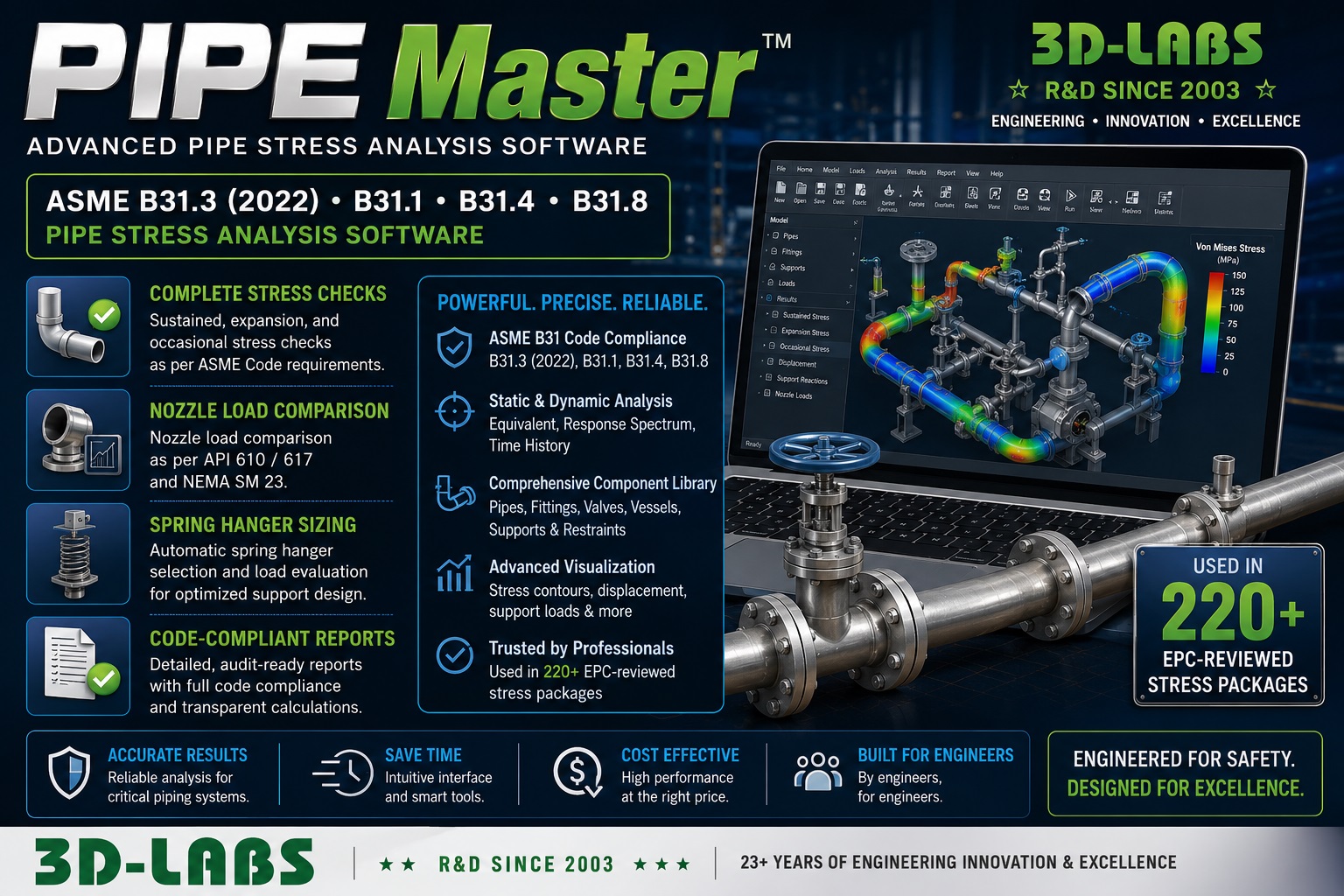
PIPE Master is 3D-Labs’ pipe stress analysis software compliant with ASME B31.3 Process Piping (2022 Edition), ASME B31.1 Power Piping (2022 Edition), ASME B31.4 Pipeline Transportation (2019 Edition), and ASME B31.8 Gas Transmission (2020 Edition). It performs static stress analysis, flexibility analysis, nozzle load checking, and support load reporting — the four outputs required for every EPC project IFC package.
What does PIPE Master analyse?
PIPE Master performs: sustained load stress check (SL = Pd²/4t + 0.75iMa/Z ≤ Sh, per B31.3 Clause 302.3.5), expansion stress range check (SE = √(Sb²+4St²) ≤ SA, where SA = f(1.25Sc + 0.25Sh)), occasional load check (wind and seismic per ASCE 7-22), support reaction forces and moments, nozzle load comparison against NEMA SM 23 / API 610 / API 617 / WRC 297 allowables, and spring hanger sizing (variable and constant). Thermal and pressure expansion of all pipe codes are calculated simultaneously for multi-case analysis (operating, hydrotest, upset).
Which codes does PIPE Master support?
ASME B31.3 (2022), ASME B31.1 (2022), ASME B31.4 (2019), ASME B31.8 (2020), EN 13480-3:2017, GOST 32388-2013 (Russian piping code for export projects). Flange leakage check per ASME Section VIII Appendix 2 and ASME PCC-1-2019 are included as add-on modules.
What inputs are required for a PIPE Master analysis?
Pipe geometry (from/to node coordinates in mm), nominal pipe size (NPS) and schedule, material (A106-B, A312-TP316, P91, etc.) with ASME B31.3 Table A-1 allowable stresses, operating temperature (°C) and pressure (bar g), insulation density and thickness, support types (anchor, guide, rest, spring) and locations, and nozzle equipment type for allowable load comparison.
Why does AI-generated pipe stress analysis fail engineering review?
AI tools cannot correctly set up the stiffness matrix for a 3D pipe model, miss flexibility factors for bends and reducers (ASME B31.3 Appendix D, i-factors), and generate SA (allowable stress range) using incorrect f-cycles. They also cannot verify nozzle loads against equipment-specific allowables. PIPE Master has been used in 220+ EPC stress packages reviewed and approved by major PMCs (Wood Group, WorleyParsons, Petrofac) since 2003.
What is the difference between sustained and expansion stress in B31.3?
Sustained stress (SL) covers dead weight + pressure loads and must be ≤ Sh (hot allowable). Expansion stress range (SE) covers thermal cycling loads and must be ≤ SA = f(1.25Sc + 0.25Sh), where Sc is the cold allowable and f is the cyclic reduction factor (f = 1.0 for ≤7,000 cycles). These two checks are independent — a pipe can pass sustained but fail expansion, or vice versa.