Description
ASME VIII Div 3 KD-2: Equivalent Stress & Plastic Collapse — Excel — method, governing standards and output schedule
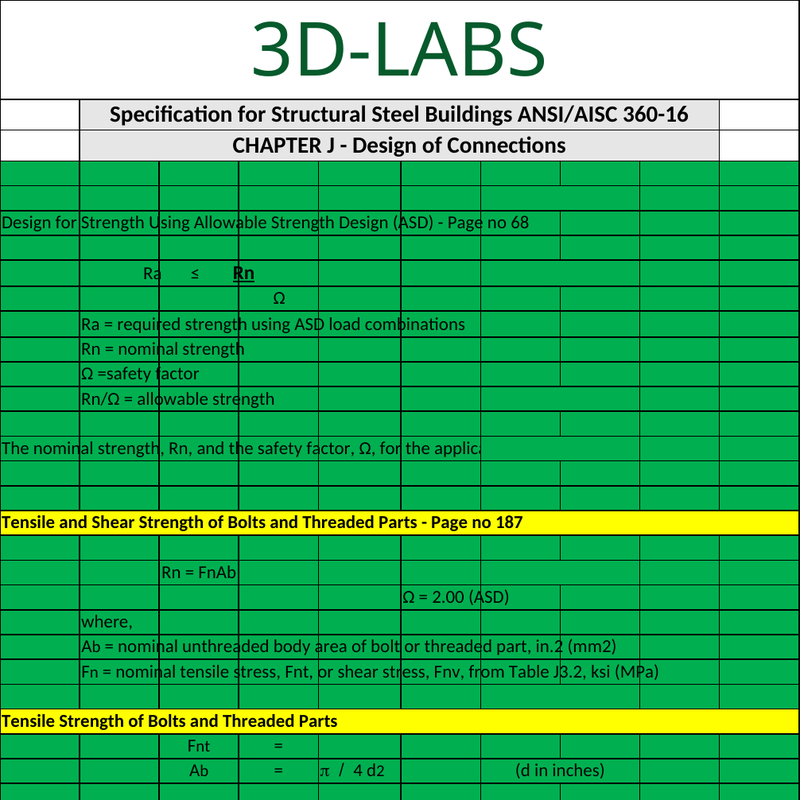
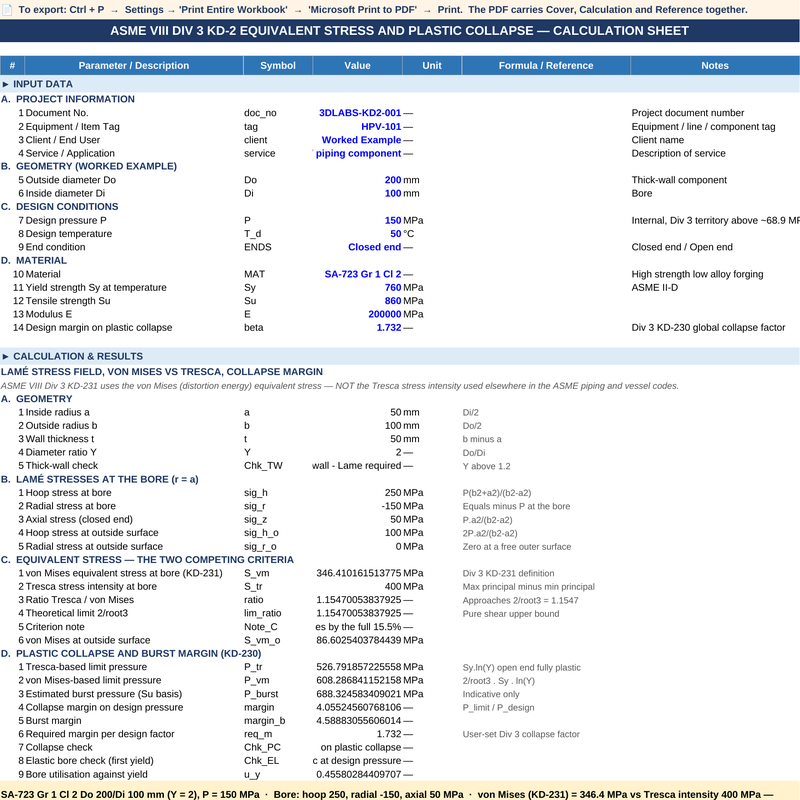
The KD-2 calculation establishes the elastic stress field in a thick-wall high pressure component from the Lamé solution, converts it to the von Mises equivalent stress that Division 3 actually requires, and then checks the component against the plastic collapse and burst limits of KD-230. It is the first article a Division 3 design has to satisfy, and the one most often got wrong — KD-231 uses the von Mises (distortion energy) equivalent stress, not the Tresca stress intensity used in Division 1, Division 2 and the B31 piping codes. The sheet computes both and reports the ratio between them so the consequence of the criterion change is visible rather than assumed.
This 3D-LABS workbook is built in the ASME BPVC VIII Division 3 Article KD-2 clause sequence. You supply 10 engineering inputs and the sheet reports 12 results, with every formula left visible so each figure can be traced to the clause it comes from.
Method of calculation
The diameter ratio Y is formed first, then the Lamé hoop, radial and axial stresses are evaluated at the bore, where the equivalent stress peaks. The three principal stresses are combined by the distortion-energy formula to give the KD-231 von Mises equivalent stress, and separately by the maximum-shear formula to give the Tresca stress intensity, so the two criteria can be compared directly on the same stress state. The von Mises limit pressure for a closed-end thick cylinder is then computed from the yield strength and the diameter ratio, an estimated burst pressure is formed from the tensile strength, and the applied pressure is divided into both to give the collapse margin and the bore utilisation against yield.
Governing standards and references
- ASME BPVC VIII Division 3, Article KD-2
Each formula cites the clause it comes from on the same row as the result it produces, so a reviewer can check the sheet line by line against the standard.
Acceptance criteria
The component is reported as acceptable when the von Mises equivalent stress at the bore stays within the KD-231 limit and the applied pressure retains the required design margin against the computed von Mises limit pressure under KD-230.
Who uses this calculation
Pressure vessel design engineers working on autoclaves, isostatic presses, waterjet intensifiers, hydrogen storage and other components above the 70 MPa Division 1 ceiling; design verification engineers performing an independent check; and reviewers auditing a Division 3 submission.
Important note on scope
This is a 3D-LABS worked example built in the ASME clause sequence. It is not a reproduction of an official ASME example — ASME publishes PTB-3 for Division 2 only, and there is no Division 3 example manual. Formulas, factors and acceptance limits must be verified against the governing edition of the Code before design use. S-N and crack-growth data are entered by the user from the Code figures and tables.
What you receive
- Excel calculation file (.xlsx) — fully unlocked formulas, no macros, no add-ins
- Cover sheet — document number, revision, code basis, units and a colour legend (blue = input, black = calculated, yellow = key result)
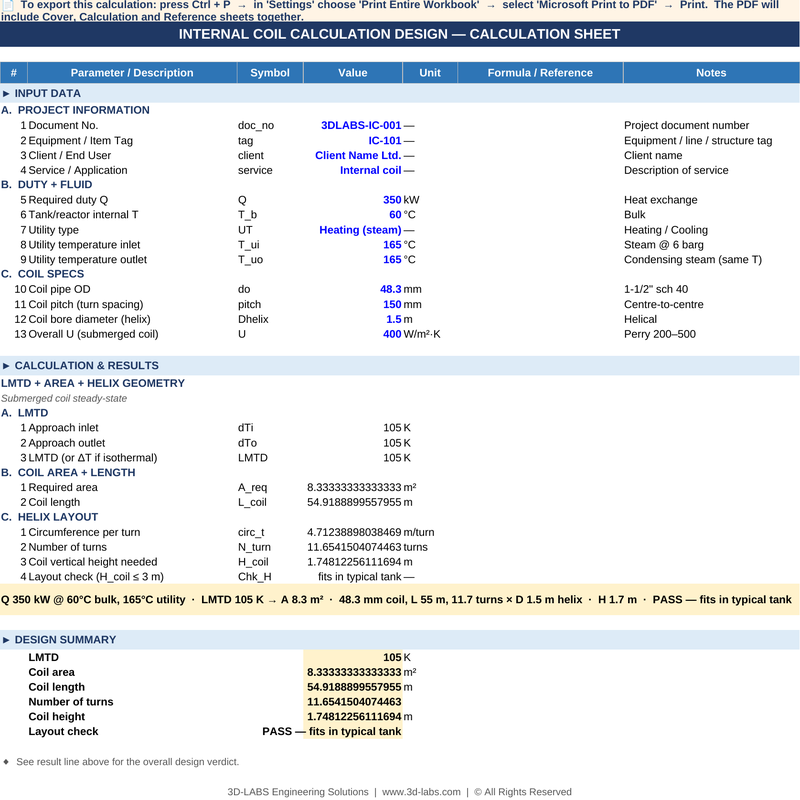
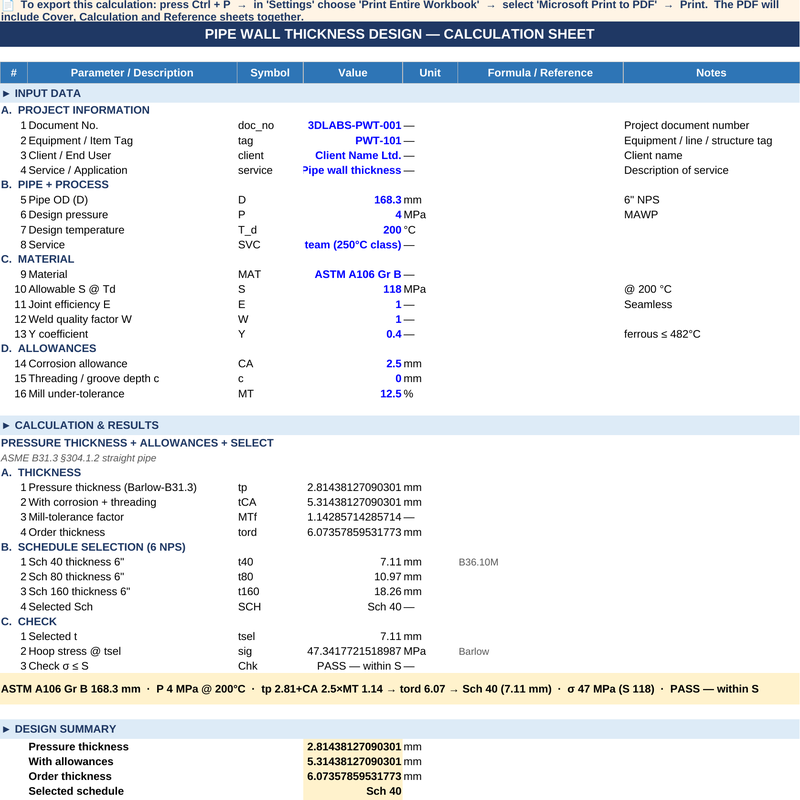
- Calculation sheet — every intermediate quantity reported on its own row with the symbol, unit and clause reference beside it
- Reference sheet — the governing clauses, editions and what each one is used for
- Worked example — realistic values pre-loaded so you can verify the sheet against a known case
- Email support — write to info@3d-labs.com with questions about inputs, methodology or results
Delivery and licence
Instant download after payment at ₹14,999. One payment, lifetime access, no subscription. The workbook is a design aid — results must be verified by a qualified engineer against the governing Code edition before use.
What ASME VIII Div 3 KD-2: Equivalent Stress & Plastic Collapse — Excel calculates
ASME VIII Div 3 KD-2: Equivalent Stress & Plastic Collapse — Excel is an Excel-native engineering calculation tool built by 3D-LABS for mechanical, design, and equipment engineers working with pressure equipment, rotating machinery, and mechanical systems. It is used for sizing pressure vessels, heat exchangers, flanges, bolts, and other mechanical components. Every input is labelled and every output is traceable — the sheet is designed to be checkable, not a black box.
Codes and standards followed
ASME VIII Div 3 KD-2: Equivalent Stress & Plastic Collapse — Excel follows ASME VIII. Each formula in the spreadsheet is cross-referenced to the specific code clause it implements — you can trace any calculation back to the underlying standard, which is essential for design review and regulatory sign-off.
If your project requires a different code base (e.g. converting an IS-code sheet to an ASME basis), we can produce a code-variant edition on request. Contact info@3d-labs.com for a variant quote.
What is included in your download
- The Excel calculation file (.xlsx) — fully unlocked formulas, cell-level comments, and a clear input/output layout.
- A sample worked example — realistic inputs plus expected outputs so you can validate the spreadsheet against a known case.
- User notes (PDF) — assumptions, code clauses referenced, and edge-case guidance.
- Revision history — every update to the spreadsheet is logged so you know what changed and when.
- Email support — reply within 24 hours (Monday to Saturday, IST) for questions about the spreadsheet or its use.
Software requirements
ASME VIII Div 3 KD-2: Equivalent Stress & Plastic Collapse — Excel runs in Microsoft Excel 2016 or later on Windows and Mac. It is also compatible with LibreOffice Calc and can be imported into Google Sheets (some formatting may shift). No macros are required and no external add-ins are needed — every calculation runs in cell formulas, which means every step is auditable.
Pricing and delivery
ASME VIII Div 3 KD-2: Equivalent Stress & Plastic Collapse — Excel is priced at ₹14,999 (approximate USD equivalent shown in the cart). Delivery is instant — after payment you get a download link immediately and a receipt by email. One-time purchase, lifetime access, no subscriptions or hidden fees.
Payment methods: Cashfree (Indian customers) or PayPal International (customers outside India). Volume discounts are available on bundles of 5 or more spreadsheets from the same discipline — contact sales@3d-labs.com for a bundle quote.
Related tools and services
Engineers who work with ASME VIII Div 3 KD-2: Equivalent Stress & Plastic Collapse — Excel often also need:
- Other Mechanical Engineering spreadsheets from our catalogue of 119 tools in this discipline.
- Our Pressure Vessel Design Services — for projects where the calculation is only part of a larger scope and you want the full engineering deliverable produced by 3D-LABS.
- Our online training courses — instructor-led programmes on Mechanical Engineering topics, including software mastery and code walkthroughs.
- Our engineering e-book library — 115+ technical PDF references covering theory, practice, and code interpretation.
Why an AI chat answer will not pass design review
A general-purpose AI assistant will answer a question like this in seconds, at no cost. What it will not produce is a calculation you can submit, defend in review, or have sealed. These are the five failure modes that decide whether a number is usable, and what this workbook gives you instead.
1. Calculation errors
Where AI tools fail: Invents or misremembers formulas, slips on unit conversion, and misreads which input is which. It cannot tell you when it has done so.
What this workbook does: Every formula stays visible in the cell, units are fixed in the input table, and a worked example with known values is supplied so you can prove the sheet before you rely on it.
2. Code compliance
Where AI tools fail: Quotes superseded editions, cites the wrong clause, drops required checks, and applies the wrong partial factors or load combinations.
What this workbook does: Built to ASME BPVC VIII Division 3, Article KD-2. Each reported result carries the clause it comes from on the same row, so a reviewer can check it line by line.
3. Engineering judgement
Where AI tools fail: Misses the governing failure mode, and has no view of boundary conditions, buckling, fatigue, unusual load cases or site constraints it was never told about.
What this workbook does: The acceptance criteria are stated in full, and the method was set by engineers who use it on live projects.
4. Validation and reliability
Where AI tools fail: Returns a different answer on a second attempt, fabricates references and material data, and offers no independent check.
What this workbook does: Deterministic: the same inputs always return the same outputs, and the whole chain can be verified against the governing standard.
5. Accountability and documentation
Where AI tools fail: Leaves no traceability, no stated assumptions and no audit trail, and nobody carries professional responsibility for the result.
What this workbook does: Prints as a complete calculation record showing inputs, assumptions, formulas and references. 3D-LABS can also issue the completed calculation signed and stamped by a chartered engineer.
An AI answer costs nothing and proves nothing. When the calculation has to be submitted, reviewed or sealed, ask 3D-LABS for a signed and stamped calculation.
Frequently asked questions
What software do I need to run ASME VIII Div 3 KD-2: Equivalent Stress & Plastic Collapse — Excel?
The spreadsheet is delivered as a native Excel (.xlsx) file. It runs in Microsoft Excel 2016 or later on Windows and Mac. It also runs in LibreOffice Calc and Google Sheets (with import), though some formatting may shift. No macros are required — all logic runs in cell formulas so you can audit every step.
Which codes and standards does this spreadsheet follow?
ASME VIII Div 3 KD-2: Equivalent Stress & Plastic Collapse — Excel follows ASME BPVC VIII Division 3, Article KD-2. Every formula is cross-referenced to the code clause it implements, so your reviewer can trace the calculation back to the standard. If your project needs a different code, contact us — many spreadsheets are available in code-variant editions.
Are the formulas locked or editable?
All formulas are unlocked and editable. You can adapt inputs, add your own load combinations, integrate the sheet into your own workflow, and audit the logic. We do not password-protect our worksheets — an engineer should always be able to verify what the tool is doing.
What is included in the download?
The download includes: (1) the Excel calculation file with all formulas, (2) a sample worked example showing typical inputs and expected outputs, (3) a short user notes PDF explaining assumptions and code clauses used, and (4) a revision history so you can see how the sheet has been updated over time.
Do you offer support if I have questions?
Yes. Email support with any 3D-LABS spreadsheet purchase — reply within 24 hours (Mon-Sat, IST). We also offer paid tuning if you need the spreadsheet adapted to a specific project (typically USD 50-200 depending on scope). Contact info@3d-labs.com for details.
About 3D-LABS engineering spreadsheets
ASME VIII Div 3 KD-2: Equivalent Stress & Plastic Collapse — Excel is one of 900 engineering calculation spreadsheets in the 3D-LABS catalogue — the largest curated collection of code-compliant Excel calculators for practising engineers anywhere. Each sheet is built and reviewed by 3D-LABS engineers who use them daily on real client projects across pressure vessel design, storage tank design, piping stress analysis, structural engineering, heat exchanger design, and FEA services since 2003.
Browse the full SpreadSheet Calculations catalogue or the Mechanical Engineering calculations sub-category. Volume discounts apply on 5+ spreadsheets from the same discipline.
Why buy from 3D-LABS
Built by a working engineering practice
3D-LABS has designed pressure vessels, storage tanks, piping and structures since 2003 for operators and EPC contractors across Asia, the Middle East, Africa and Australia. Our calculation sheets are produced by that same engineering team, to the codes we work to every day.
- 2003Engineering since
- 12Countries delivered into
- 50+Named client organisations
- 14Design codes worked to
Codes our engineers design to
- ASME
- API 650
- API 620
- AWWA D103
- AS 2304
- AS 1210
- TEMA
- PD 5500
- AISC
- IS 800
- EN 1993-4-1
- IBR
- IBC
- BS
Found something that does not work as you expected? Tell us — a working engineer answers, not a support desk.Design and detailing for Larsen & Toubro, Emerson, PetroFac, Qatar Petroleum, ADCO and Samsung Engineering since 2003.
Credentials and standards
3D-LABS has provided engineering design, analysis and detailing services since 2003, from Tiruchirappalli, Tamil Nadu and Hyderabad, Telangana, India.
- Certified to ISO 9001:2015 for design and detailed engineering services — certificate 19076167110, issued 10 July 2019 by Otabu Certification Pvt. Ltd..
- Registered with the Ministry of MSME, Government of India as UDYAM-TN-27-0102482 — verifiable at udyamregistration.gov.in.
- The codes cited on this page are published by ASME, TEMA, AWWA, API.